Securitron Magnalock M680E with EcoMag technology EPD
Open the original PDF document
View PDFSecuritron M680E with EcoMag Technology®
Magnalock
ASSA ABLOY is committed to providing products and services that are environmentally sound throughout the entire production process and the product lifecycle. Our unconditional aim is to make sustainability a central part of our business philosophy and culture, but even more important is the job of integrating sustainability into our business strategy. The employment of EPDs will help architects, designers and LEED-APs select environmentally preferable door openings.
ASSA ABLOY will continue our efforts to protect the environment and health of our customers/end users and will utilize the EPD as one means to document those efforts.
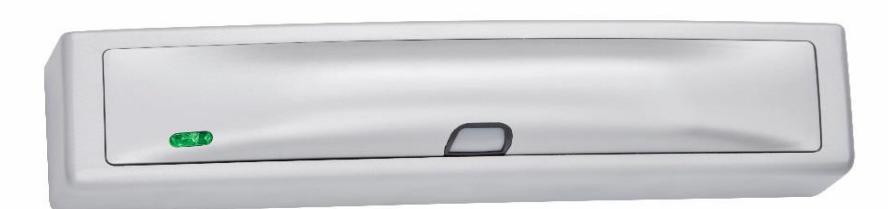
The Securitron M680E with EcoMag technology delivers the same unsurpassed intelligence, style and convenience as the previous M680 series, but with up to 80% reduction in energy consumption.
Environmental Product Declaration According
Securitron M680E with EcoMag Technology®


to
This declaration is an environmental product declaration (EPD) in accordance with ISO 14025. EPDs rely on Life Cycle Assessment (LCA) to provide information on a number of environmental impacts of products over their life cycle. Exclusions: EPDs do not indicate that any environmental or social performance benchmarks are met, and there may be impacts that they do not encompass. LCAs do not typically address the sitespecific environmental impacts of raw material extraction, nor are they meant to assess human health toxicity. EPDs can complement but cannot replace tools and certifications that are designed to address these impacts and/or set performance thresholds – e.g. Type 1 certifications, health assessments and declarations, environmental impact assessments, etc. Accuracy of Results: EPDs regularly rely on estimations of impacts, and the level of accuracy in estimation of effect differs for any particular product line and reported impact. Comparability: EPDs are not comparative assertions and are either not comparable or have limited comparability when they cover different life cycle stages, are based on different product category rules or are missing relevant environmental impacts. EPDs from different programs may not be comparable.
| PROGRAM OPERATOR | UL Environment | ||||
|---|---|---|---|---|---|
| DECLARATION HOLDER | ASSA ABLOY/ Securitron | ||||
| DECLARATION NUMBER | |||||
| DECLARED PRODUCT | Securitron M680E with EcoMag Technology® | ||||
| REFERENCE PCR | Builders Hardware PCR UL 9004 | ||||
| DATE OF ISSUE | March 15, 2018 | ||||
| PERIOD OF VALIDITY | 5 Years | ||||
| Product definition and information about building physics | |||||
| Information about basic material and the material's origin | |||||
| Description of the product's manufacturing | |||||
|
CONTENTS OF THE
DECLARATION |
Indication of product processing | ||||
| Information about the in-use conditions | |||||
| Life cycle assessment results | |||||
| Testing results and verifications | |||||
| The PCR review was conducted by | The Independent Expert Committee, SVR | ||||
| by Underwriters Laboratories | This declaration was independently verified in accordance with ISO 14025 | ||||
| INTERNAL | EXTERNAL | UL Environment | |||
|
This life cycle assessment was independently verified in accordance with
ISO 14044 and the reference PCR by |
|||||
1 Exclusions: EPDs do not indicate that any environmental or social performance benchmarks are met, and there may be impacts that they do not encompass. LCAs do not typically address the sitespecific environmental impacts of raw material extraction, nor are they meant to assess human health toxicity. EPDs can complement but cannot replace tools and certifications that are designed to address these impacts and/or set performance thresholds , e.g., Type 1 certifications, health assessments and declarations, environmental impact assessments, etc. Accuracy of Results: EPDs regularly rely on estimations of impacts, and the level of accuracy in estimation of effect differs for any particular product line and reported impact. Comparability: EPDs are not comparative assertions and are either not comparable or have limited comparability when they cover different life cycle stages, are based on different product category rules or are missing relevant environmental impacts. EPDs from different programs may not be comparable.

Securitron M680E with EcoMag Technology®

Product Definition and Information
Product Description
Product name: Securitron M680E with EcoMag Technology®
Product characteristic: Magnalock
The Securitron M680E with EcoMag is a powerful, energy efficient maglock. Addtional features include:
- Strike plate mounting template provides the easiest install for out-swing doors
- LED Indicator shows the lock is secure, open, or has an incomplete bond as well as error codes for troubleshooting
- Tamper Switch sends an alarm output if the cover is removed and is selectable to NO or NC
- BondSTAT and integrated Door Position Switch
- Autosensing dual voltage with microprocessor technology
- Adjustable automatic relock timer (0 to 30 seconds)
- Wire chamber anti-tamper switch
- Energy efficient, low power usage
- Size optimized for use with door closers
- MagnaCare® lifetime replacement, no fault warranty
Application
The Securitron M680E with EcoMag Technology® is ideal for a wide range of applications, including but not limited to:
- High security applications
- Fail safe, high traffic exits
- Stairwells, vestibules, or other interior or protected perimeter outswing doors
- Commercial, retail, healthcare, education, and government institutions
- Aesthetically demanding installations like museums and galleries
- Short doorways where maglock protrusion is a concern
Technical Data
For the declared product, the following technical data in the delivery status must be provided with reference to the test standard:
| Technical Data | ||||
|---|---|---|---|---|
| Length | 11.5" | |||
| Depth | 2.5625" | |||
| Height | 2.5" | |||
| Holding Force | 1200 lbs (544 kg) | |||
| Finish | Multiple Finishes | |||
Placing on the Market / Application Rules
The standards that can be applied for the Securitron M680E with EcoMag Technology® are:
- UL 10C Fire Rated 1 Hour
- CAN/ULC-S104 Fire Door Conformant
- UL 1034 Burglary-Resistant Listed
- UL 294 Recognized Component
- ANSI/BHMA A156.23, Grade 2; E18501
- Carolina State Fire Marshall Listed

Securitron M680E with EcoMag Technology®

Delivery Status
Shipments of Securitron M680E products are delivered in a 17 x 4 x 6" cardboard box. All necessary installation hardware and instructions are included.
Base Materials / Ancilary Materials
| Material | Percentage in mass (%) |
|---|---|
| Stainless Steel | <1% |
| Steel | 77% |
| Aluminum | 16% |
| Electronics/Mechanics | 1% |
| Plastics | 2% |
| Other | 4% |
| Total | 100.00% |
Manufacture
The primary manufacturing processes are made by Tier 1 suppliers and the final manufacturing processes occur in Phoenix, AZ. The components come from processes like stamped steel, turning, and aluminum extrusion.
Environmental and Health During Manufacturing
ASSA ABLOY is committed to producing and distributing door opening solutions with minimal environmental impact, where health & safety is the primary focus for all employees and associates.
- Environmental operations, GHG, energy, water, waste, VOC, surface treatment and H&S are being routinely monitored. Inspections, audits, and reviews are conducted periodically to ensure that applicable standards are met and environment management program effectiveness is evaluated.
- Code of Conduct covers human rights, labor practices and decent work. Management of ASSA ABLOY is aware of their environmental roles and responsibilities, providing appropriate training, supporting accountability and recognizing outstanding performance.
- Any waste metals during machining are separated and recycled. The waste from the water-based painting process is delivered to waste treatment plant.
- The factory in Phoenix, AZ have certification of Environmental Management to ISO 14001:2004 and Occupational Health and Safety to OHSAS 18001:2007.
Product Processing / Installation
Securitron M680E products are distributed through and installed by trained installation technicians, such as locksmiths, carpenters etc. adhering to local/national standards and requirements.
Packaging
Shipments of Securitron products are delivered in a cardboard box with cornstarch foam inserts. The foam packaging material is a biobased cornstarch material that is fully biodegradable and compostable according to ASTM D-6400.
| Material | Quantity (% By Weight) |
|---|---|
| Cardboard | 93% |
| Cornstarch Foam | 7% |
| Total | 100% |

Securitron M680E with EcoMag Technology®

Conditions of Use
No cleaning or annual maintenance is required.
Environmental and Health During Use
There is no harmful emissive potential. No damage to health or impairment is expected under normal use corresponding to the intended use of the product.
Reference Service Life
The reference service life is 20 years
Extraordinary Effects
Fire
No negative environmental impact will result from exposure to fire.
Water
Contains no substances that have any impact on water in case of flood.
Mechanical Destruction
No danger to the environment can be anticipated during mechanical destruction.
Re-use Phase
The product can be moved from one door to another during the reference service life, thus enabling re-use.
Disposal
The product can be mechanically dissembled to separate the different materials. 100% of the materials used are recyclable. The remainder of components are disposed of according to standard municipal solid waste deposition.
Further Information
ASSA ABLOY Electromechanical Specialties & OEM Group 10027 S. 51st Street, Ste. 102 Phoenix, AZ 85044
Life Cycle Assessment
Declared Unit
The declaration refers to the functional unit of 1 unit (or piece) of Securitron M680E with EcoMag Technology®, as specified in the Builders Hardware PCR
| Name | Value | Unit |
|---|---|---|
| Declared unit | 1 | Magnalock |
| Mass | 4.590 | kg |
| Conversion factor to 1 kg | 0.218 | - |

Securitron M680E with EcoMag Technology®
Door Hardware

According to ISO 14025
System Boundary
This is a cradle to gate with options Environmental Product Declaration. The following life cycle phases were considered:
| Pro | duct St | age |
truction
ss Stage |
Use Stage End of Life Stage* |
Benefits and
Loads Beyond the System Boundaries |
||||||||||||
|---|---|---|---|---|---|---|---|---|---|---|---|---|---|---|---|---|---|
| Pow motorial | Transport | Manufacturing | Transport from gate to the site |
Construction/
installation process |
Use | Maintenance | Repair | Replacement | Refurbishment | Operational energy use | Operational water use |
Deconstruction
/demolition |
Transport | Waste processing | Disposal |
Reuse-
Recovery- Recycling potential |
|
| A1 | A2 | A3 | A4 | A5 | B1 | B2 | В3 | B4 | B5 | В6 | B7 | C1 | C2 | C3 | C4 | D | |
| Χ | Χ | Χ | Χ | Х | MND | MND | MND | MND | MND | MND | MND | MND | Χ | Х | Χ | X | |
Description of the System Boundary Stages Corresponding to the PCR (X = Included; MND = Module Not Declared)
Estimates and Assumptions
End of Life
In the End of Life phase, for all the materials which can be recycled, a recycling scenario with 100% collection rate was assumed.
Cut-off Criteria
In the assessment, all available data from the production process are considered, i.e. all raw materials used, auxiliary materials (e.g. lubricants), thermal energy consumption and electric power consumption - including material and energy flows contributing less than 1% of mass or energy (if available). In case a specific flow contributing less than 1% in mass or energy is not available, worst case assumption proxies are selected to represent the respective environmental impacts. Impacts relating to the production of machines and facilities required during production are out of the scope of this assessment.
Background data
For life cycle modeling of the considered products, the GaBi 8 Software System for Life Cycle Engineering, developed by thinkstep, is used. The GaBi-database contains consistent and documented datasets which are documented in the online GaBi-documentation. To ensure comparability of results in the LCA, the basic data of GaBi database were used for energy, transportation and auxiliary materials.
Data Quality
The data sources used are complete and representative of North America in terms of the geographic and technological coverage and are a recent vintage (i.e. less than ten years old). The data used for primary data are based on direct information sources of the manufacturer. Secondary data sets were used for raw materials extraction and processing, end of life, transportation, and energy production flows. Wherever secondary data is used, the study adopts critically reviewed data for consistency, precision, and reproducibility to limit uncertainty.

* This includes provision of all materials, products and energy, packaging processing and its transport, as well as waste processing up to the end-of waste state or disposal of final residues.
Environmental Product Declaration According
Securitron M680E with EcoMag Technology®


to
Period Under Review
The period under review is the full calendar year of 2017.
Allocation
Allocation was determined on a per unit basis.
Comparability
A comparison or an evaluation of EPD data is only possible if all data sets to be compared were created according to EN 15804 and the building context, respectively the product-specific characteristics of performance, are taken into account. Environmental delarations from different programs may not be comparable. Full conformance with the PCR for North American Builders Hardware products allows EPD comparability only when all stages of a Builders Hardware product's life cycle have been considered. However, variations and deviations are possible.
LCA: Modeling Scenarios and Additional Technical Information
The following technical information is a basis for the declared modules or can be used for developing specific scenarios in the context of a building assessment if modules are not declared.
| Installation into the building (A5) | ||||||
|---|---|---|---|---|---|---|
| Name | Value | |||||
| Auxiliary | - | kg | ||||
| Water consumption | - |
3
m |
||||
| Other resources | - | kg | ||||
| Electricity consumption | - | kWh | ||||
| Other energy carriers | - | MJ | ||||
| Material loss | - | kg | ||||
|
Output substance following waste treatment
on-site |
0.27 | kg | ||||
| Dust in the air | - | kg | ||||
| VOC in the air | - | kg | ||||
| Reference Service Life | |||
|---|---|---|---|
| Unit | Name | Value | Unit |
| Reference Service Life | 20 | years |
| End of life (C1-C4) | ||||||
|---|---|---|---|---|---|---|
| Name | Value | Unit | ||||
| Collected separately | 4.59 | kg | ||||
| Collected as mixed construction waste | 0.00 | kg | ||||
| Reuse | 0.00 | kg | ||||
| Recycling | 3.41 | kg | ||||
| Energy recovery | 0.24 | kg | ||||
| Landfilling | 0.94 | kg | ||||
LCA Results
Results shown below were calculated using TRACI 2.1 Methodology.
| TRACI 2.1 Impact Assessment | |||||||||
|---|---|---|---|---|---|---|---|---|---|
| Parameter | Parameter | Unit | A1-A3 | A4 | A5 | C2 | C3 | C4 | D |
| GWP | Global warming potential |
kg CO2
-Eq. |
1.7E+01 | 3.4E-01 | 4.9E-02 | 2.1E-02 | 3.1E-03 | 5.6E-03 | -5.3E+00 |
| ODP |
Depletion potential of the
stratospheric ozone layer |
kg CFC-11 Eq. | 1.9E-09 | 1.3E-11 | 1.1E-13 | 8.1E-13 | 1.1E-13 | 6.6E-15 | 1.8E-07 |
| AP Air |
Acidification potential for air
emissions |
kg SO2
-Eq. |
7.7E-02 | 2.0E-03 | 2.8E-04 | 1.3E-04 | 1.9E-05 | 2.6E-05 | -1.3E-02 |
| EP | Eutrophication potential | kg N-Eq. | 3.6E-03 | 1.1E-04 | 4.8E-05 | 7.1E-06 | 9.0E-07 | 9.5E-06 | -9.9E-05 |
| SP | Smog formation potential |
kg O3
-Eq. |
9.2E-01 | 5.6E-02 | 2.6E-03 | 3.5E-03 | 4.5E-04 | 1.0E-04 | -1.2E-01 |
| FFD | Fossil Fuel Depletion | MJ-surplus | 1.3E+01 | 6.0E-01 | 1.6E-02 | 3.8E-02 | 5.0E-03 | 8.5E-04 | 6.3E-01 |

Securitron M680E with EcoMag Technology®
Door Hardware

According to ISO 14025
Results shown below were calculated using CML 2001 - April 2013 Methodology.
| CML 4.1 I | mpact Assessment | ||||||||
|---|---|---|---|---|---|---|---|---|---|
| Parameter | Parameter | Unit | A1-A3 | A4 | A5 | C2 | C3 | C4 | D |
| GWP | Global warming potential | kg CO 2 -Eq. | 1.6E+01 | 3.4E-01 | 3.1E-01 | 2.1E-02 | 3.1E-03 | 6.4E-03 | -5.3E+00 |
| ODP |
Depletion potential of the
stratospheric ozone layer |
kg CFC-11 Eq. | 1.8E-09 | 1.3E-11 | 1.1E-13 | 8.0E-13 | 1.0E-13 | 6.2E-15 | 1.6E-07 |
| AP Air | Acidification potential for air emissions | kg SO 2 -Eq. | 7.8E-02 | 1.7E-03 | 1.8E-04 | 1.1E-04 | 1.6E-05 | 9.9E-06 | -1.2E-02 |
| EP | Eutrophication potential | -Eq. | 6.0E-03 | 3.0E-04 | 6.7E-05 | 1.9E-05 | 2.4E-06 | 1.1E-05 | -3.6E-04 |
| POCP |
Formation potential of
tropospheric ozone photochemical oxidants |
kg ethane-Eq. | 7.0E-03 | 2.0E-04 | 3.9E-05 | 1.2E-05 | 1.9E-06 | 2.6E-06 | -2.6E-03 |
| ADPE |
Abiotic depletion potential for non-
fossil resources |
kg Sb-Eq. | 1.8E-04 | 1.4E-10 | 9.5E-09 | 8.8E-12 | 5.3E-12 | 2.7E-10 | -5.3E-05 |
| ADPF | Abiotic depletion potential for fossil resources | MJ | 2.0E+02 | 4.3E+00 | 1.4E-01 | 2.7E-01 | 3.9E-02 | 6.8E-03 | -5.6E+01 |
Results below contain the resource use throughout the life cycle of the product.
| Resource U | Resource Use | ||||||||
|---|---|---|---|---|---|---|---|---|---|
| Parameter | Parameter | Unit | A1-A3 | A4 | A5 | C2 | C3 | C4 | D |
| PERE | Renewable primary energy as energy carrier | MJ | 3.8E+01 | 0.0E+00 | 1.8E-02 | 0.0E+00 | 0.0E+00 | 5.7E-04 | 2.8E+00 |
| PERM | Renewable primary energy resources as material utilization | MJ | 5.2E+00 | 0.0E+00 | 0.0E+00 | 0.0E+00 | 0.0E+00 | 0.0E+00 | 0.0E+00 |
| PERT | Total use of renewable primary energy resources | MJ | 4.3E+01 | 0.0E+00 | 1.8E-02 | 0.0E+00 | 0.0E+00 | 5.7E-04 | 2.8E+00 |
| PENRE | Nonrenewable primary energy as energy carrier | MJ | 2.1E+02 | 4.3E+00 | 1.5E-01 | 2.7E-01 | 4.1E-02 | 7.1E-03 | -5.0E+01 |
| PENRM | Nonrenewable primary energy as material utilization | MJ | 5.2E+00 | 0.0E+00 | 0.0E+00 | 0.0E+00 | 0.0E+00 | 0.0E+00 | 0.0E+00 |
| PENRT | Total use of nonrenewable primary energy resources | MJ | 2.2E+02 | 4.3E+00 | 1.5E-01 | 2.7E-01 | 4.1E-02 | 7.1E-03 | -5.0E+01 |
| SM | Use of secondary material | MJ | 0.0E+00 | 0.0E+00 | 0.0E+00 | 0.0E+00 | 0.0E+00 | 0.0E+00 | 0.0E+00 |
| RSF | Use of renewable secondary fuels | MJ | 0.0E+00 | 0.0E+00 | 0.0E+00 | 0.0E+00 | 0.0E+00 | 0.0E+00 | 0.0E+00 |
| NRSF | Use of nonrenewable secondary fuels | MJ | 0.0E+00 | 0.0E+00 | 0.0E+00 | 0.0E+00 | 0.0E+00 | 0.0E+00 | 0.0E+00 |
| FW | Use of net fresh water | m 3 | 3.0E+01 | 0.0E+00 | 9.5E-03 | 0.0E+00 | 0.0E+00 | 3.1E-04 | -1.1E-02 |

Securitron M680E with EcoMag Technology®
Door Hardware

According to ISO 14025
Results below contain the output flows and wastes throughout the life cycle of the product.
| Output Flow | Output Flows and Waste Categories | ||||||||
|---|---|---|---|---|---|---|---|---|---|
| Parameter | Parameter | Unit | A1-A3 | A4 | A5 | C2 | C3 | C4 | D |
| HWD | Hazardous waste disposed | kg | 5.2E-05 | 0.0E+00 | 0.0E+00 | 0.0E+00 | 0.0E+00 | 0.0E+00 | -2.7E-03 |
| NHWD |
Non-hazardous waste
disposed |
kg | 3.2E-05 | 0.0E+00 | 0.0E+00 | 0.0E+00 | 0.0E+00 | 0.0E+00 | 1.3E-01 |
| RWD | Radioactive waste disposed | kg | 3.4E-03 | 0.0E+00 | 3.6E-06 | 0.0E+00 | 0.0E+00 | 1.2E-07 | 1.7E-03 |
| CRU | Components for re-use | kg | 0.0E+00 | 0.0E+00 | 0.0E+00 | 0.0E+00 | 0.0E+00 | 0.0E+00 | 0.0E+00 |
| MFR | Materials for recycling | kg | 7.3E-01 | 0.0E+00 | 2.7E-01 | 0.0E+00 | 3.0E-02 | 0.0E+00 | 2.6E-02 |
| MER | Materials for energy recovery | kg | 0.0E+00 | 0.0E+00 | 0.0E+00 | 0.0E+00 | 0.0E+00 | 0.0E+00 | 0.0E+00 |
| EEE | Exported electrical energy | MJ | 0.0E+00 | 0.0E+00 | 0.0E+00 | 0.0E+00 | 0.0E+00 | 0.0E+00 | 0.0E+00 |
| EEE | Exported thermal energy | MJ | 1.4E-07 | 0.0E+00 | 2.6E-01 | 0.0E+00 | 0.0E+00 | 2.0E-03 | 0.0E+00 |
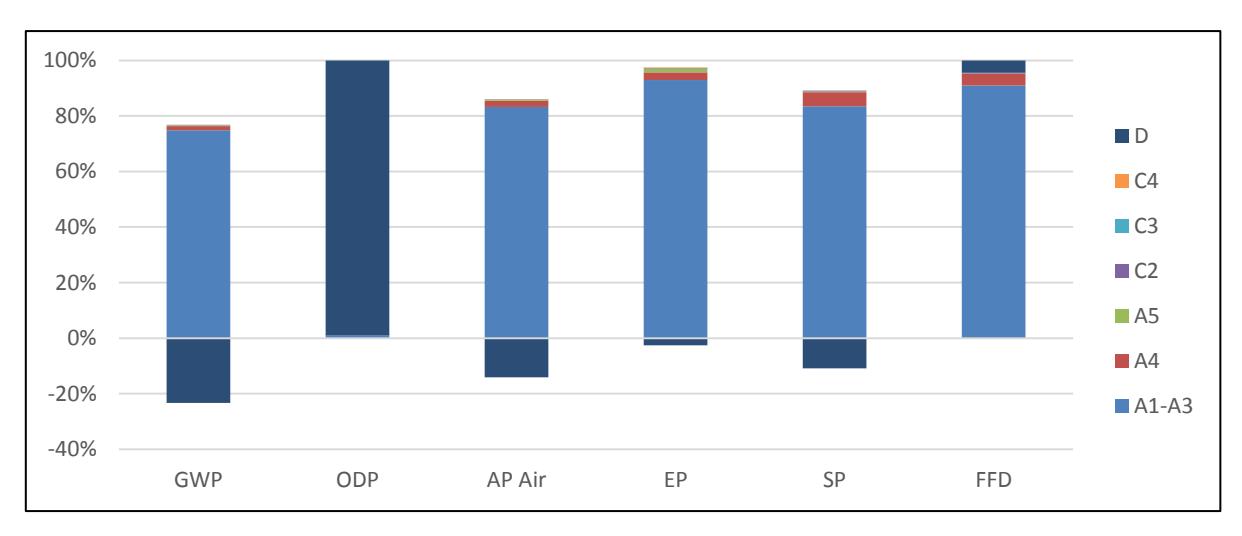
The production life cycle stage (A1-A3) dominates the impacts across all impact categories, with the exception of ozone depletion. This is due to the upstream production of metals used in the product, along with electricity use in the manufacturing of the product. Potential benefits are due to the potential avoided burden of recycled materials after disposal.

Environmental Product Declaration According
Securitron M680E with EcoMag Technology®


to
References
|
PCR Part A
- |
UL Environment and Institut Bauen und Umwelt e.V., Königswinter (pub.): Product Category Rules
for Construction Products from the range of Environmental Product Declarations of Institut Bauen und Umwelt (IBU), Part A: Calculation Rules for the Life Cycle Assessment and Requirements on the Background Report. July 2014, version 1.3 |
|---|---|
| PCR Part B | UL Environment and Institut Bauen und Umwelt e.V. (IBU). Product Category Rules Part B: |
| - | Requirements on the Environmental Product Declaration for Builders Hardware |
| GaBi 6 | thinkstep.one: GaBi Software-System and Databases for Life Cycle Engineering. version 6.110. |
| - | Copyright, TM. Stuttgart, Echterdingen. 1992-2015 |
| ISO 14025 | ISO 14025:2011-10, Environmental labels and declarations — Type III environmental declarations |
| - | — Principles and procedures. |
| ISO 14040 | ISO 14040:2009-11, Environmental management — Life cycle assessment — Principles and |
| - | framework. |
| ISO 14044 | ISO 14044:2006-10, Environmental management — Life cycle assessment — Requirements and |
| - | guidelines. |
| EN 15804 | EN 15804:2012-04: Sustainability of construction works — Environmental Product Declarations — |
| - | Core rules for the product category of construction product |
|
ULE 2013
- |
UL Environment, General Program Instructions, 2013. |
| - | US EPA, Tool for the Reduction and Assessment of Chemical and Other Environmental Impacts |
| TRACI 2.1 | (TRACI) |
| - | Center of Environmental Science of Leiden University impact categories and characterisation |
| CML 2001 | methods for impact assessment (CML) |